
Made to Please at All Costs: The Dopamine Generation
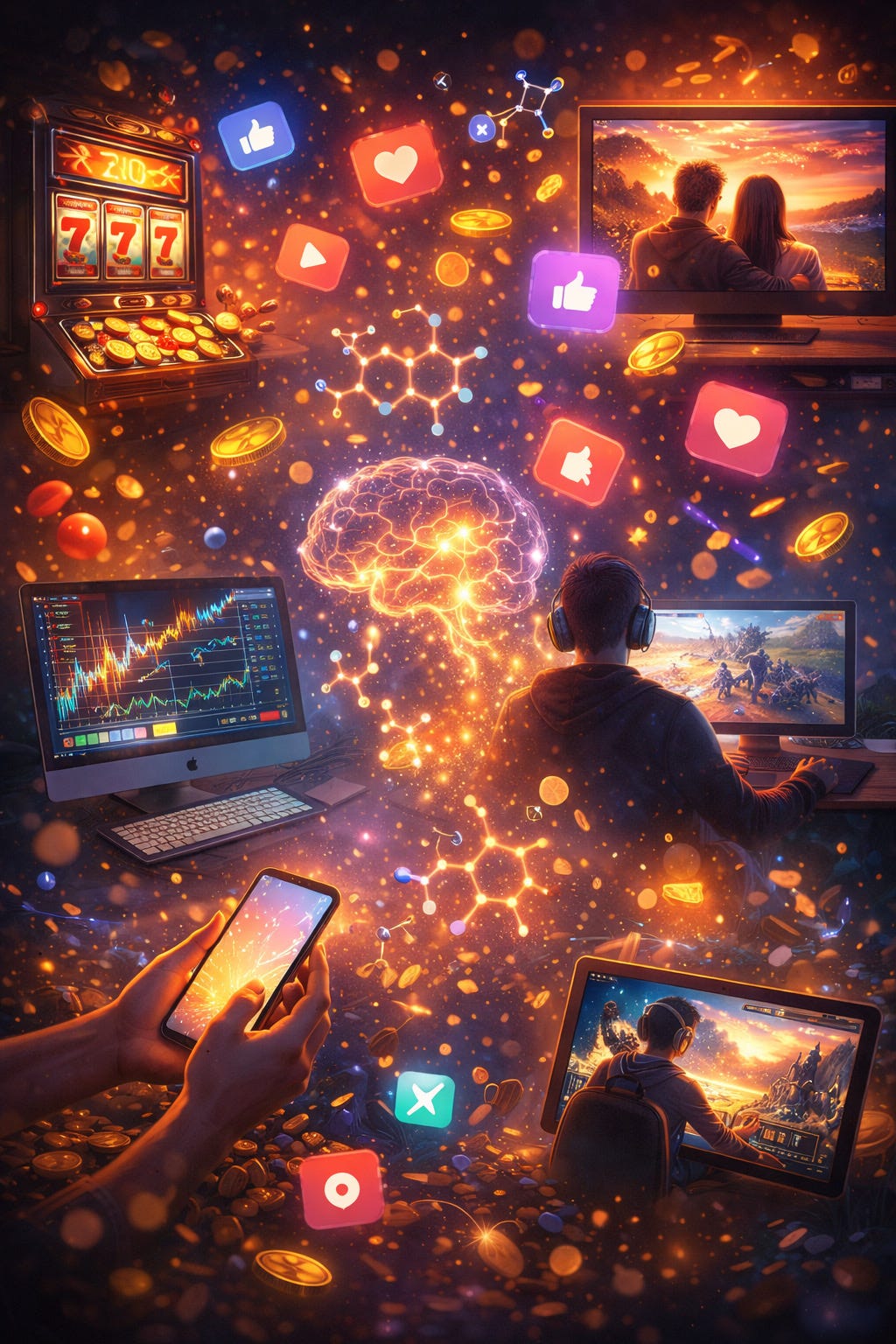
We are living through a silent experiment on the human brain.
Years ago, addiction had a face. You could see it in casinos. You could see it in slot machines. You could see it in the person sitting for hours pulling a lever, hoping the next spin would change everything. Scientists later explained why. It wasn’t just hope. It was dopamine. The brain chemical of anticipation. Not even the reward itself, but the possibility of a reward.
The slot machine never paid consistently. That was the secret. Sometimes you win. Most times you lose. But your brain keeps chasing the possibility. That uncertainty creates a stronger hook than certainty ever could.
What once existed only inside casinos has now been placed inside everyone’s pocket.
The same psychological mechanisms now live inside phones, social media, video games, and endless scrolling feeds. The same variable reward system. The same anticipation. The same neurological hook. Except now you don’t have to be 21 years old to enter. Now a 10-year-old can carry a casino in their hand.
Before, addiction required you to go somewhere. Now it follows you everywhere.
And the most concerning part is this: this generation did not gradually adapt to it. They were born into it. They never experienced boredom the way previous generations did. They never had to sit quietly with their thoughts. The moment discomfort appears, a screen removes it. The brain never develops the same resistance to frustration because stimulation is always one swipe away.
We are now seeing the consequences:
Shorter attention spans.
Lower tolerance for effort.
Higher anxiety.
Higher depression.
Constant comparison.
Constant stimulation.
Constant distraction.
Not because this generation is weaker, but because they were placed inside a system designed by behavioral psychologists whose job was to make these platforms as hard to leave as possible.
This is not accidental design. It is engineered engagement.
The same principles that kept gamblers in front of slot machines now keep millions refreshing screens. Notifications became the new jackpot sounds. Likes became the new coins dropping. Infinite scrolling became the new lever pull.
And the danger is not just addiction. It is numbness.
When the brain gets used to constant stimulation, normal life starts to feel boring. Real growth feels slow. Real relationships feel demanding. Real success feels too far away. The brain starts preferring quick dopamine instead of meaningful progress.
But life was never meant to be lived chasing small artificial rewards. Real satisfaction comes from building something, learning something, overcoming something, becoming someone.
This is not a call to reject technology. Technology is a tool. But tools can build or they can enslave depending on who is in control.
The real question is no longer: “Do we use technology?”
The real question is: “Is technology using us?”
Because a generation that cannot control its attention will struggle to control its future.
And maybe the greatest discipline of this generation will not be physical strength, but mental strength. The ability to disconnect. The ability to focus. The ability to delay gratification. The ability to sit in silence and still move forward.
Because the strongest people in the future may simply be the ones who learned how to turn the noise off.
My son knows that video game addiction changed his brain for the worse, and he's worked hard to break his addiction. But he doesn't see the connection between that and his belief that he is my daughter. Luckily for my my grandchildren, his sisters see clearly.
Yes! "When the brain gets used to constant stimulation, normal life starts to feel boring. Real growth feels slow. Real relationships feel demanding. Real success feels too far away. The brain starts preferring quick dopamine instead of meaningful progress."
Excellent post!