
The Emperor’s New Identity
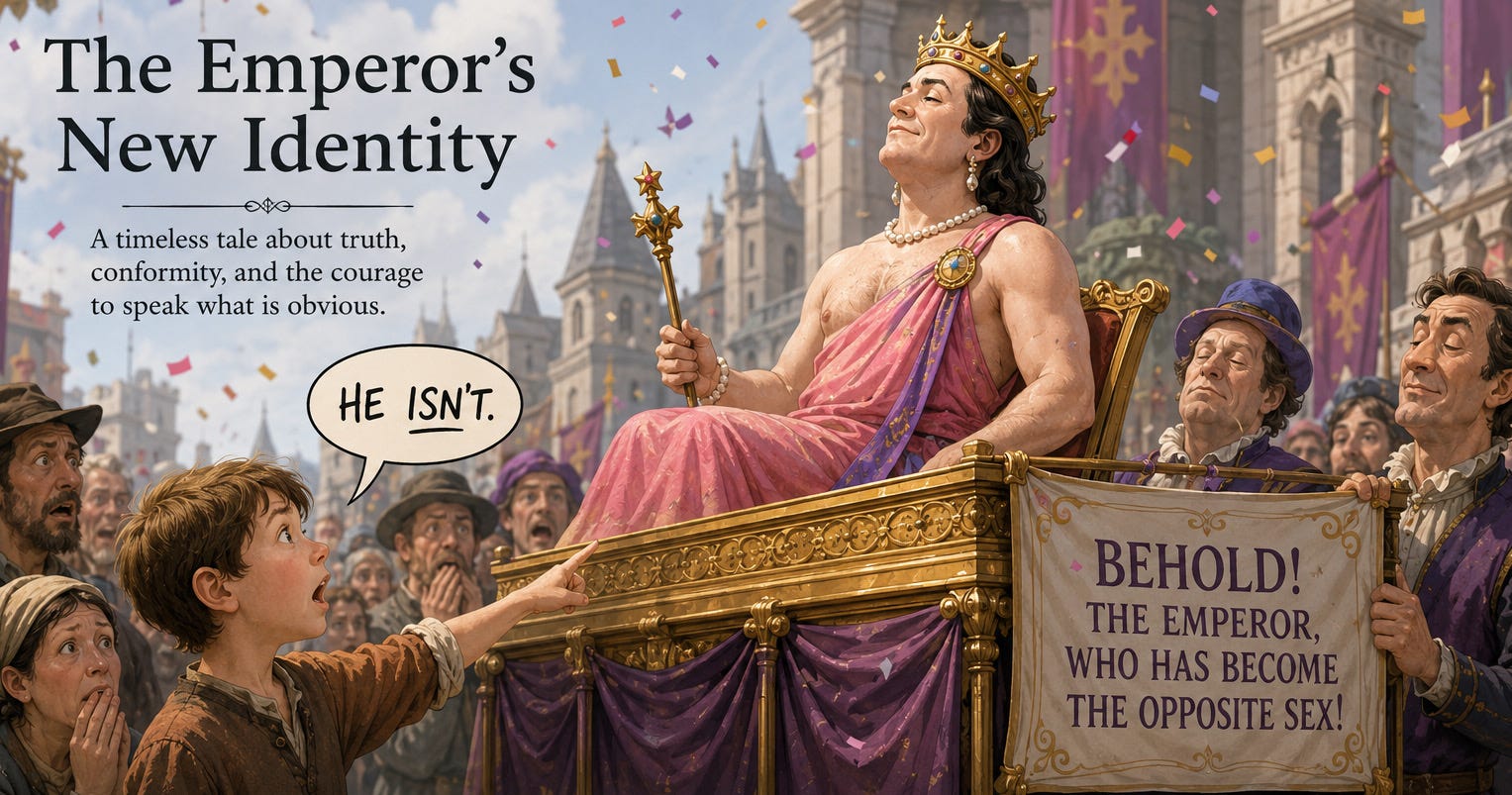
I am the father of two trans identified sons. I wrote the attached short story.
Long ago, there lived an emperor who possessed everything a ruler could desire—wealth, power, admiration, and influence. Yet despite having all these things, he was deeply dissatisfied. He became convinced that the person he truly was did not match the person everyone else saw. Though every mirror reflected the same image, and though every official record described the same individual he had always been, the emperor increasingly insisted that these things were mistaken.
One day, two clever courtiers arrived at the palace. Sensing the emperor’s unhappiness, they offered him something no one else had. “Your Majesty,” they said, “we can help you become whoever you wish to be.” The emperor leaned forward with interest. “Can you make me into the opposite gender?” he asked. The courtiers smiled knowingly. “We can do something even better,” they replied. “We can persuade everyone that you already are.”
The emperor was delighted. The courtiers immediately set to work. They held meetings with government officials, educators, journalists, physicians, and judges. They explained that a person’s true identity could not be determined by physical appearance, biology, history, or observation. Those things, they said, were superficial and often misleading. What mattered most was a person’s internal sense of self. Therefore, if the emperor declared himself to be the opposite gender, then that declaration should be accepted as reality.
Many people found the argument confusing. Some quietly wondered how a declaration could change something so fundamental. Others asked questions about biology, language, and objective truth. But the courtiers dismissed such concerns. “You must learn to see beyond appearances,” they explained. “Those who disagree simply have not yet reached a proper understanding.” Few people wished to be viewed as ignorant or unkind, so most remained silent.
As time passed, the new doctrine spread throughout the kingdom. The emperor continued to appear exactly as he always had, but everyone was expected to address him as though he were the opposite gender. Those who complied were praised as compassionate and enlightened. Those who hesitated risked criticism, social embarrassment, or accusations of prejudice. Many citizens privately admitted to one another that they were confused, but each assumed everyone else truly believed. Because no one wanted to stand apart from the crowd, the performance continued.
Soon the kingdom began adjusting itself to accommodate the new reality. Official documents were rewritten. Language was revised. Portraits were relabeled. Schools taught children that the emperor was exactly what he declared himself to be and that any conflict between observation and affirmation should be resolved in favor of affirmation. Over time, many people learned to suppress what they saw and repeat what they were expected to say.
The emperor grew increasingly confident. Surrounded by constant affirmation, he came to believe that the matter was settled. To celebrate this triumph, he announced a grand parade through the capital city. Citizens gathered from across the kingdom to watch. The streets were packed with spectators as heralds marched before the emperor’s carriage proclaiming, “Behold! The Emperor, who has become the opposite gender!”
The crowd applauded. Some cheered enthusiastically. Others joined in because everyone around them was doing the same. A few remained silent. Among the spectators stood a young child. Unlike the adults, the child had not yet learned the social art of ignoring obvious contradictions. The child listened to the heralds, looked at the emperor, and then looked again.
Finally, the child tugged on a parent’s sleeve and asked, loud enough for others nearby to hear, “Why does everyone keep saying the emperor is the opposite gender?” The parent immediately grew nervous and whispered for the child to be quiet. But the child persisted. “I don’t mean any harm,” the child said. “I just don’t understand. He isn’t.”
For a moment there was silence. Then a few people exchanged uncertain glances. Someone quietly repeated the child’s words. Another nodded. Soon whispers spread through the crowd. Many realized they had been suppressing the same thought for years. They had doubted their own perceptions because they feared standing alone. Now they discovered they were not alone at all.
The emperor heard the murmuring. The courtiers heard it too. Officials shifted uncomfortably. The crowd’s applause faded. No one knew quite what to do next. Thechild had not shouted insults. The child had not expressed hatred or malice. The child had merely stated what seemed obvious.
And in that moment the kingdom found itself confronting a deeper question than the identity of the emperor. It had to decide whether reality would be determined by what people could plainly observe or by what they were expected to affirm. The answer to that question would shape the kingdom’s future long after the parade had ended.
For sometimes the most disruptive words are not spoken by rebels or philosophers, but by ordinary people who simply refuse to deny what they can plainly see.
Exactly our reality. With no end in sight.
“The child had not expressed hatred or malice. The child had merely stated what seemed obvious.”
Except when that “obvious” is expressed, it is instantly turned into accusations of hatred and malice.
Hence the eggshells I so lightly tread every day.
Very well-written piece. My heart is with you.
Trans nonsense can only have been generated to destroy the host organism, just like every other liberal trope.
Follow the animal kingdom and nature. God designed a perfect environment which man has attempted to destroy