
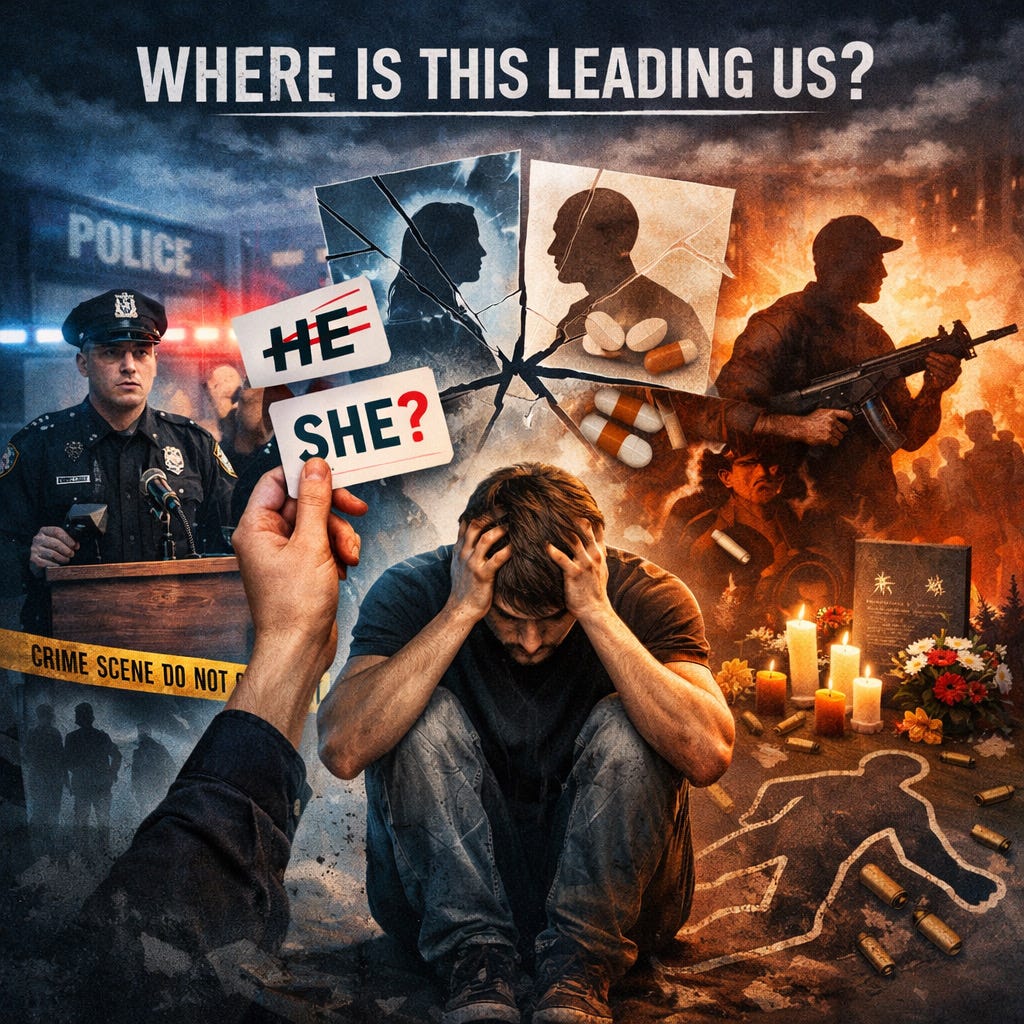
Yesterday, during a press conference about a horrific act of violence, something stood out to me. A biological male committed a shooting. A reporter referred to the suspect as “he.” An official corrected it to “she.”
That moment wasn’t about grammar. It revealed something deeper about the direction of our culture.
Let’s step back from politics and ask a harder question.
Statistically, nearly every mass shooting over the last several decades has been committed by biological males. This pattern stretches across countries, cultures, and generations. It predates modern debates about gender identity. Violence at that scale is overwhelmingly a male phenomenon.
So what is happening with men?
We are clearly facing a crisis in male mental health. Isolation, resentment, identity confusion, anger without purpose, untreated trauma. These are not political talking points. They are realities documented in research.
But instead of carefully examining the psychological roots of this crisis, we often seem to respond with affirmation first and evaluation second.
Compassion is essential. But compassion without careful clinical assessment can become something else entirely.
When someone struggles deeply with identity, that pain deserves thoughtful, professional attention. It deserves rigorous psychological care. It deserves honesty.
The concern is not about attacking individuals who are struggling. The concern is about whether society has become too quick to validate every self-concept without asking harder diagnostic questions.
History shows that untreated mental distress does not remain static. It evolves. It deepens. It can manifest in many directions: depression, addiction, self-harm, rage. The overwhelming majority of people who struggle never become violent. But we cannot ignore the broader pattern that serious violence is almost exclusively male and that male distress is rising.
Where were these identity crises in the 70s, 80s, and 90s at the scale we see today? Why are so many young men reporting confusion, alienation, and detachment from their own bodies and purpose? Is this purely individual, or are there social influences amplifying vulnerability?
These are legitimate questions.
If a person believes something about themselves that causes severe distress, the humane response is not mockery. It is not cruelty. But neither is it automatic affirmation without exploration.
Mental health care should be evidence-based, cautious, and individualized. Especially with young people.
We must be careful not to let ideology replace clinical judgment.
The issue is not compassion versus rejection. The issue is whether we are truly helping people, or simply validating them without addressing deeper roots.
Society owes struggling young men more than slogans.
It owes them truth, structure, purpose, and careful psychological care.
If we cannot have that conversation honestly, we risk continuing down a path we do not fully understand or ever will.
Check out Sayer Ji's explosive piece this morning that chronicles how Jeffery Epstein (using banker money) paid researchers and surgeons to manufacture false trans research and ill-developed medical procedures. At least one researcher, Robert Trivers, said he went along because he needed the money.
The mental health violence against white boys and men you chronicled above has been manufactured by billionaire psychopaths.
The families here have been harmed by criminal sociopaths at the highest levels of society, via their professional prostitutes in medicine, education, and psychotherapy.
Excellent point: "The issue is not compassion versus rejection. The issue is whether we are truly helping people, or simply validating them without addressing deeper roots." OR are affirming physicians and 'kind' society driving already fragile young men even further into mental illness?