
Connecting the dots
Dear friends,
I want to share a reflection that has been forming in my heart and mind for some time now, especially after my first ROGD meeting and the many conversations I’ve had with parents in this group.
One of the first things that struck me was how often we fail to connect the dots.
I want to be very clear from the beginning: I do not like to generalize. I am not saying this applies in all cases. But I am saying that in a large number of cases, the similarities are too strong, too frequent, and too consistent to simply dismiss.
When you hear the same story repeated again and again, from different families, different cities, different backgrounds, at some point you have to ask yourself: is this really coincidence, or are we looking at a pattern?
Many of these stories seem to converge around the same time period: during Covid.
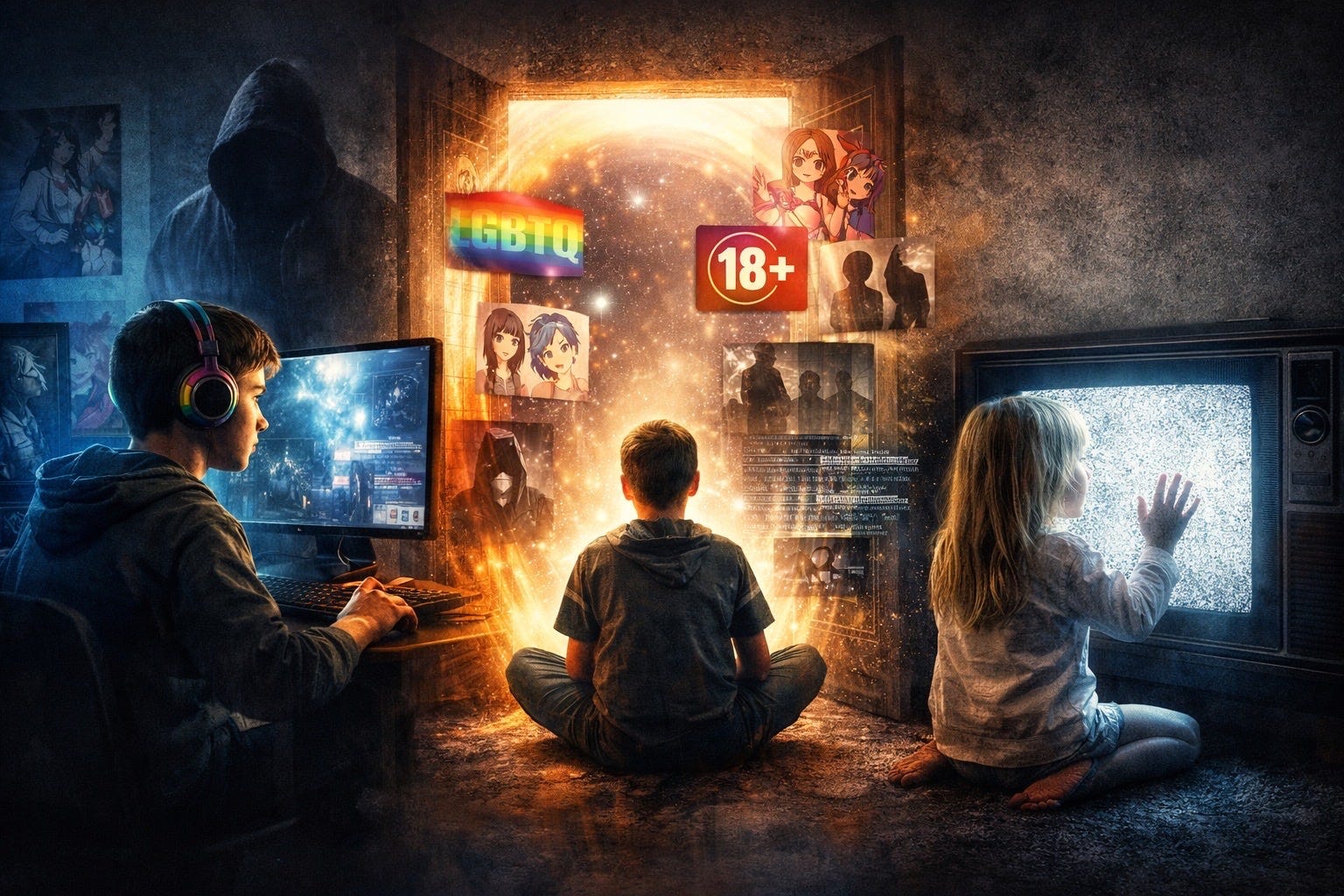
During lockdowns, internet use became universal and constant. Screens were no longer just entertainment; they became social life, community, escape, and identity. And in many homes, there was little ability to monitor what was being consumed or how deeply.
Doors that once felt distant suddenly became wide open.
And inside those doors were things many of us never imagined our children would be immersed in: excessive gaming, unfiltered social media, pornography, anime culture, niche online communities, and in some cases even darker corners of the internet. This exposure was not gradual. It was intense, immersive, and often isolating.
I can speak personally about my own son.
He was highly intelligent, a straight-A student, introverted, sensitive, and had never had a girlfriend. That description alone mirrors what so many parents here describe. His entry point was fighting video games. From there, he joined the Fighting Game Community. As many of you already know, these spaces are overwhelmingly LGBTQ-dominated.
Over time, the changes became impossible to ignore. He began withdrawing from family life. He spent less time in shared spaces and more time isolated. His language changed. His behavior changed. His way of thinking changed. It felt as if the child we knew was slowly being replaced by someone else.
What unsettled me most was realizing how familiar this story sounded.
Again and again, I read posts or listen to parents describe their children in almost identical ways. Intelligent. Introverted. Socially anxious. Deeply immersed in online communities. Heavy gamers. No prior history of gender distress. Then suddenly, the same certainty appears. The same phrases. The same framing. The same rejection of questions. The same belief that transition is the only acceptable path.
And when parents hesitate, question, or ask for time, they are often cast as obstacles rather than protectors.
What troubles me deeply is how rigid this belief system becomes. Transition is presented as inevitable. Dissent is treated as hostility. Those who detransition are dismissed, silenced, or portrayed as traitors. Their stories are often ignored, even though they may carry the very warnings others need to hear.
When I spoke with parents at our ROGD meeting, I asked a simple question. Every single one of them answered the same way: yes, their child was addicted to video games.
At what point do we stop calling this coincidence?
There are countless videos online of gamers openly discussing taking estrogen, claiming it makes them feel calmer, more sensitive, or more “in tune” while playing. Whether people are comfortable acknowledging this or not, this content exists, and it reaches vulnerable minds.
Sometimes I think about the movie Poltergeist, where the little girl sits in front of the television, mesmerized by the static, until she is eventually pulled inside. Not because screens are evil in themselves, but because prolonged exposure without guidance can shape perception, identity, and belief in powerful ways.
I want to be careful here. I am not interested in promoting conspiracy theories. But there is a difference between inventing conspiracies and asking reasonable questions when patterns repeat themselves with such consistency.
When so many young people use the same language, follow the same sequence of steps, anticipate the same objections, and deliver the same answers almost word for word, it is fair to ask: where did this script come from?
Who prepared them for this moment?
Who taught them what to say, when to say it, and how to frame their parents as adversaries if they resist?
Who guided them to see affirmation as love and caution as harm?
Because when behavior, speech, emotional responses, and even conflict strategies look this similar across so many unrelated families, coincidence becomes harder to accept.
That does not require believing in a single mastermind or a hidden plot. But it does suggest influence. Guidance. Ideological training. Mentorship. Something shaping these narratives long before the conversation ever reaches the family.
And that is the question that remains.
Not asked in anger.
Not asked in fear.
But asked in responsibility.
If the same roadmap is being followed again and again, then pretending we don’t see it does not protect our children. It only delays the moment when we finally confront what is happening right in front of us.
And so I will end this letter the same way I began it:
These patterns are real.
These similarities are too consistent.
And they are no longer something we can ignore.
Yes, the kids use the "same roadmap" and scripts. We must connect the dots to figure out how to disconnect them and reclaim our kids from the cult that ensnared them.
I make no apologies for being a conspiracy theorist.
You are right in identifying the effect the plandemic had on children and in promoting sexual deviance. That was the intent all along.
We are in damage control mode, which means that parents must be a brick wall between their children and anything LGBT. It is doable.