
The Power of a Narrative – A Letter From a Gen-X Parent
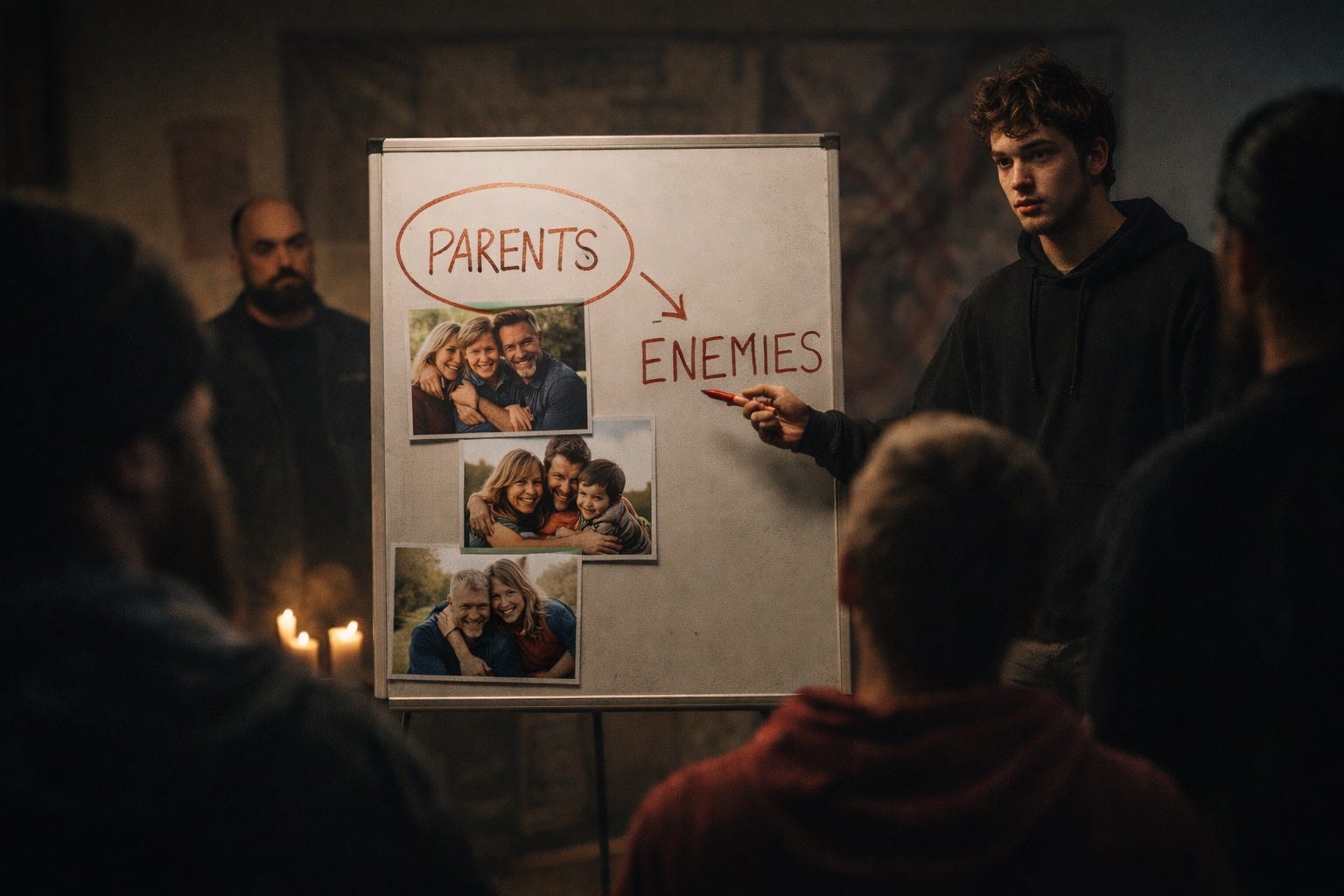
I want to get something off my chest. Something I know many parents feel, even if most of us carry it quietly in our own homes and in our own hearts.
Sometimes we share it with our spouse. Sometimes with a close friend. But most of the time, it is something we carry silently.
I am a Gen-X father. We are from a generation that learned through real life. We were not raised on theories. We learned from experience, from struggle, from responsibility, from consequences. Life taught us lessons the hard way, and those lessons shaped who we are today.
And yet, even with all that life experience, many of us now find ourselves trying to understand something that sometimes feels not only unimaginable, but inexplicable.
What I keep coming back to is this:
The power of a narrative.
The power of environment.
The power of influence.
Especially when that narrative is constantly reinforced by communities, online spaces, or ideological leaders who position themselves as guides, mentors, or even saviors.
Because when a narrative becomes strong enough, it can make someone question even the very people who loved them the most.
My son once said, in front of us and other families during a lunch, how happy and privileged he felt to have been born into our family. That moment stayed with me because it reflected what my wife and I dedicated our entire lives to doing.
We sacrificed. Not because we had to. Because we wanted to.
We gave them the best schools we could afford. We were present at every game, every play, every important moment. We hosted friends, supported their dreams, showed affection openly. In our home there were hugs, there was presence, there was family.
We tried to give them not just material things, but emotional security. Stability. Love.
We always believed parents should lead by example. We did not drink. We did not use drugs. We avoided behaviors that would make our children ashamed of us. Not because we were perfect, but because we understood that children learn more from what they see than from what they hear.
Then COVID hit. Isolation came. Screens became the main environment. Online communities became louder than family voices. Video games became social spaces. And along with that came ideologies and narratives powerful enough to reshape how young people see themselves and their families.
And suddenly, a son who once felt grateful now seems emotionally unreachable.
I understand adulthood. I understand independence. I understand that a 23-year-old must live his own life.
This is not about control.
This is about something much harder to understand: how does someone become emotionally disconnected from parents who still show nothing but love?
When messages of love are sent and ignored.
When simple “how are you?” texts go unanswered.
When a mother sends a childhood memory, a baby outfit she saved with his name on it, just to say, “I miss you today,” and there is not even a simple acknowledgment.
Not anger. Not disagreement.
Just silence.
And what hurts is not disagreement. What hurts is indifference.
Because most parents reading this would understand distance if there had been abuse. If there had been violence. If there had been toxic behavior.
But when there was love… presence… stability… and the result is emotional distance anyway, you start asking yourself difficult questions.
And that is when I return to what I mentioned at the beginning: the power of narrative.
When a narrative teaches young people that their families are obstacles to their “true identity”… when it suggests that distance from parents is necessary for “self-discovery”… when it frames loving concern as oppression… then even good families can suddenly be recast as enemies in a story they never even knew they were part of.
As parents, we are left trying to understand how so many families, in different places, with different backgrounds, are experiencing such similar situations.
And we ask ourselves: how can the same pattern appear in so many homes?
The only explanation that makes sense to me is influence. Environment. Narrative.
And when human explanations stop making sense, that is where faith begins to hold us together.
The only true comfort my wife and I have found is in our faith in Jesus Christ. There was a moment when the pain became too heavy for us to process alone. And it was exactly there, in our weakness, that we felt God holding us up.
We still cry sometimes.
But now we cry with hope.
Because we believe God works in His time, not ours.
So, we pray. We wait. We trust. We love from a distance if necessary. And we refuse to let bitterness replace love in our hearts.
We believe that one day our son may look back and see clearly again. That he may rediscover the foundation he came from. That he may understand that love was never the enemy.
We see many young people rediscovering faith. Especially recently, seeing people turn back to Christ. And we pray that one day he may also find his way not back to us first, but back to truth, back to purpose, and back to God.
Because when someone finds their way back to truth, reconciliation often follows.
Until then, we remain what we have always been:
Parents who love.
Parents who wait.
Parents who pray.
And parents who hope that one day the noise of the world becomes quieter than the voice of truth.
Not a parent but a formerly trans identified teen, now an adult. After desisting I knew firsthand the power of a narrative and how I abandoned something that my life once revolved around. I ended up researching cults, learning the mechanism of manipulation, why a group or a leader can get someone to truly believe nonsense that defies what they see, hear, and experience. Manipulative people and ideologies prey on the vulnerabilities of young people, because teenage and young adulthood is a time where you don't know who you are or what you're doing, and naturally have a desire to rebel. Another major vulnerability is mental health disorders, which are alarmingly prevalent among trans identified teens. They are already hurting and lonely. Covid made this even worse. In my experience and from what I have seen, trans ideology and those preaching it tells you the only way to fix your mental health is to transition, and once you believe that belief they say we accept you and anyone who doesn't hates you. Throw in the fearmongering about bigotry and hatred and even a "trans genocide" and it will turn disagreement into fear and hatred for you. Once the group is your only friends, they withdraw affection when you act out of line. If your story doesn't follow their narrative, if you say the wrong thing, hold a wrong opinion, you are shunned. Connection and love are very strong human needs, as social creatures being alone is a threat to us, its wired in our brain that we must have companionship before we are truly safe. So you will try to get it back, by censoring yourself and conforming. But watching your mouth leads you to watch your thoughts, because one wrong move and you lose companionship. This is what leads people to not only change their mind but also their own memory perception, if it doesn't fit a narrative the story must be fixed, as the narrative cannot be questioned. This is how cults operate, isolation and shunning is widely used in cults because it is effective at controlling people. I have written more in depth about this topic and similar, I repost all my work on this account
From my experience with an adult child with a personality disorder, it is not indifference, but rather deep personal shame, because deep down, they know how privileged they are to have been raised in such a warm and loving home by such sacrificial parents, and it it just too hard for them to admit it. So keep sending the sweet memories & texts, etc. and one day your child may very well come around and acknowledge how blessed they are to have you and your family. A good psychiatrist helped us to see that the anger & vitriol once displayed and spewed towards loving family members was actually a hatred of herself. With much therapy, education, and hard work, this has for the most part passed and we have our lovely child back [for the most part].