
The reason our trans-identified daughter stopped taking testosterone? Vanity
Our daughter was infected by the trans virus in 2016, at the age of about 13. We were living in an eastern European country at the time and believe she came in contact with the trans idea at her international school, or through social media, or most likely both.
My husband is European and I am an American who has lived in Europe since the late 1980s. He and I are both older parents, having adopted our daughter in Russia as a baby when we were already in our 40’s. At 13 months, she was a bit underweight but showed no signs of developmental delay. With us, she grew up in happy, upper middle-class circumstances: private schools, nannies, soccer team, horseback riding, swimming lessons, family trips. Never an honour student, she excelled in every sport she tried and held her own academically. All in all, we had more than a decade of normalcy and, I’ll say it, joy.
The “Mom, I’m trans” announcement came in writing, via the Skype chat we used at the time. It was a weekday evening; she and I were both at home and my husband was out of town for work. A few weeks earlier, she and her best friend had both got short haircuts, and I’d noticed my daughter was wearing baggier clothing and hunching to hide her breasts. This written salvo, however, took me by surprise.
I’d seen the high-profile media stories about “trans kids,” and had adopted a live-and-let-live attitude about it. For a little while, my daughter had been telling me about a girlfriend who was planning to “come out” to her parents about being trans. I just listened and let her talk, thinking to myself, “Damn, how are they going to handle it?” But hey, that was their problem, not ours.
But now my own girl was texting me from downstairs, saying that she was really a boy and wanted to get hormones and “top surgery.” The language of her text was clearly some kind of script and not her own words. When I called her to come talk with me in the same room, I would have to describe her mood as euphoric. My pulse was racing and my stomach turning, but I decided to just listen as she chattered on excitedly using the unfamiliar vocabulary of trans. I asked questions and listened and promised more conversation the next day.
In the days that followed, I gleaned as much as I could from material available online, which wasn’t much, apart from a lot of weirdly uniform pro-trans content. I joined and then swiftly got ejected from a couple of Facebook parent groups – for asking questions about side effects, irreversible physical changes, long-term outcomes, etc. Soon enough, my husband and I knew where we stood on the matter and told our daughter: dress as you like, wear your hair as you like, but you are female and nothing will change that. We do not support any form of transition.
We said at the time but regretted it later: “This is a decision for an adult, and you will not be legally an adult until you are 18.” She was only 13 at the time, and age 18 seemed like the distant future . . .
Faced with non-affirming parents, she turned dark and hostile, at times violent. Living with her was like walking on eggshells all the time. Anything could set her off. She slung accusations and insults: “You don’t love me, because you don’t accept me.” “You’re transphobes, bigoted old losers.” And so on. Once she brandished a kitchen knife at me, and for several subsequent nights I wished we had a lock on the bedroom door.
When I finished my assignment in that country and our daughter was 16 years old, we packed up and moved back to my husband’s country, which was familiar and beloved by all of us. We hoped the change of scenery and peer group would snap her out of the trans obsession, but it only seemed to get worse. In retrospect, I think she used the trans identity as “cred” to help her integrate into the new school. It was around this time that she somehow managed to procure a chest binder.
We tried a family vacation in the mountains, but with her nonstop hostility towards us, it wasn’t much fun. She brought along a high-end digital camera we had given her, continuously demanded I take portraits of her, and then complained contemptuously about my skills as a photographer. I took hundreds of photos of her that week, in poses clearly meant to emphasize her sharp jawline and flattened, overdressed upper body.
I took her to a respected diagnostic psychotherapist. After two full days of testing, the evaluation was: anxiety, depression, and “social pragmatic communication disorder” which apparently used to fall under the autism umbrella. Though concerning, these were diagnoses we thought might be a form of protection in the future against hasty action on the part of gender doctors, but of course that proved to be a foolish assumption.
After some delay owing to the COVID pandemic – and surgery to correct a facial birthmark – at age 19 our daughter moved to a neighbouring country for university-level studies. Before she departed, my husband and I made one last effort to talk her out of medicalising. We laid out the list of risks: heart disease, cancer, pelvic floor dysfunction, clitoral growth, sterility. She dismissed it all, insisting that she was an adult and it was her body and nobody could tell her what to do with it. Furthermore, she made it clear she couldn’t wait to get away from us.
In no time she found a clinic near her school and started testosterone injections. I don’t need to tell you how frightening it was to hear her voice gradually lowering on our periodic phone conversations, or how revolting it was to see her bloated head and body, huge thighs, and the ever-denser moustache and beard when she came home for Christmas and summer breaks. I won’t dwell on any of that because now I want to get to the good news.
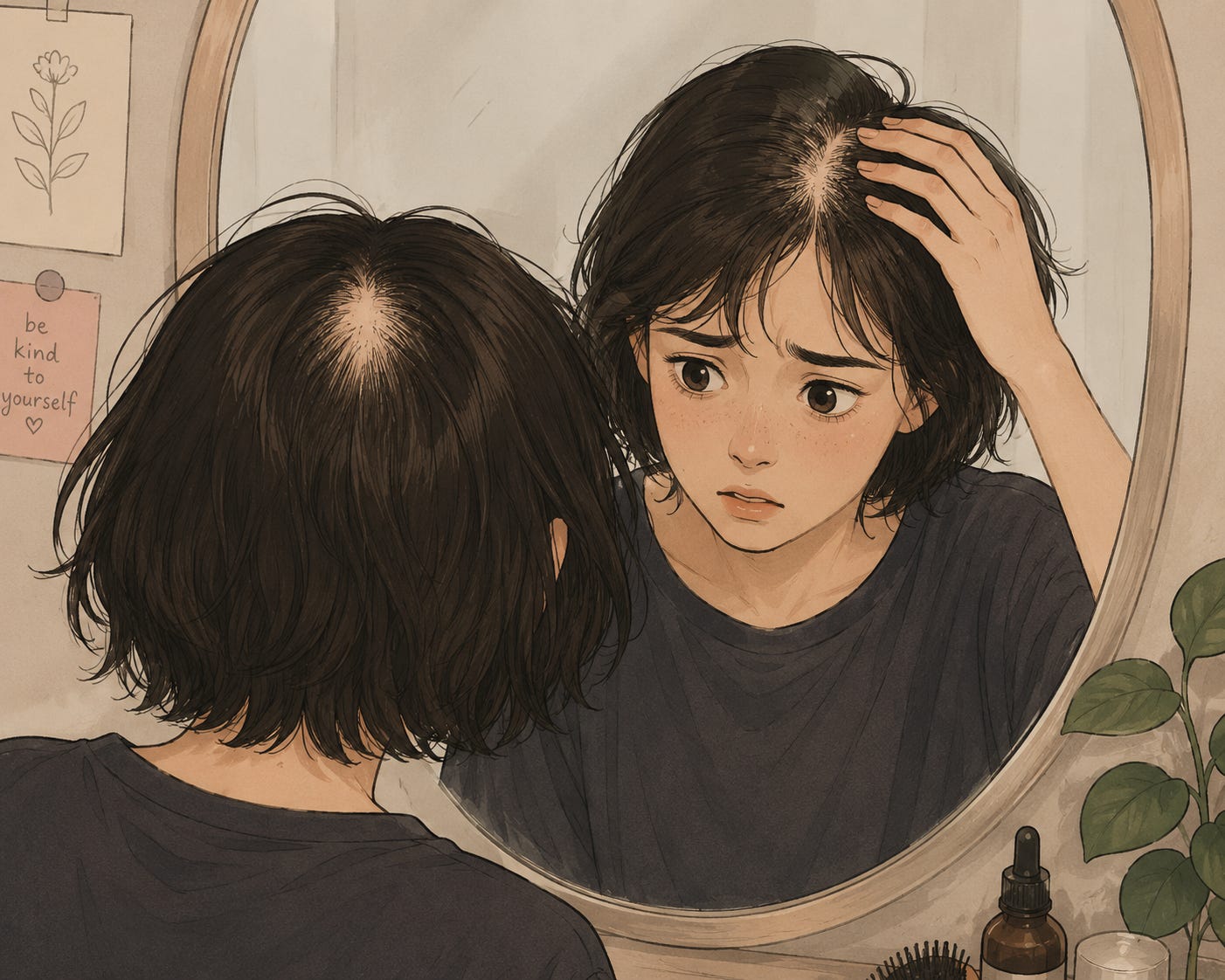
After about two years, our daughter decided to stop the testosterone because of one particular side effect: male-pattern balding. She had had other health problems, too: high cholesterol and blood pressure readings, unexplained urinary tract infections, and possibly other issues that she chose not to share with me. But it was the bald spot and the receding hairline that really bothered her. She also told me that she didn’t like the shape of her face on testosterone – it gave her sort of a pumpkin head and interfered with the “snatched” jaw she always liked to show off when posing for photos. She still identifies as “trans,” she is quick to say, but is satisfied with the changes she achieved and feels no need to continue.
It has been over a year now without testosterone, and we have observed changes. On the physical side: she is having her period again, the thinning hair has largely filled in, her face shape has returned to normal, she has lost the extra weight and muscle mass, and the pitch of her voice has risen slightly. She says her blood pressure and cholesterol values are back to normal, but she is still battling UTIs. Mentally and emotionally, she is less aggressive and easier to be around.
In a few months she will finish her studies, and all indications are that she will soon be financially self-supporting. She keeps in touch with her father and me via the family WhatsApp chat, and perhaps a weekly phone call to me. It’s not the relationship I would like, but so much better than even a year ago.
Our experience underscores two things. First, that the situation with a trans-identified kid can be dynamic – as they mature, as they experience side effects, as public discourse on trans topics becomes more open and varied, and as their own interests expand.
Second, that vanity can be an important lever. Since our daughter cut off her beautiful, long, wavy hair years ago, we never realised that the thickness of her hair was still important to her. And though she had rejected her youthful female beauty, she was still subject to vanity and hated the puffed-up face and head that testosterone gave her.
Ours is not a story about detransition, since for now our daughter still “lives as” a man in her world. We do not know whether she will ever reassume her original identity as a strong, athletic, bossy girl, but we are grateful that vanity effectively led her to prioritise her health. We are also grateful that she has never cut ties with us. We choose to feel hopeful, and I think this is a message other parents might appreciate reading.
Thank you for the measured, level headed and realistic account of your daughter’s journey and yours as you navigate it all. Not an easy path I know but evidently quite common in our world today. The hope is that they will realize the consequences and turn toward wisdom, health and healing instead of the destruction that is being offered by medical, psychological & cultural industries. The choice is theirs.
What a relief for you! Hopefully, as she matures, she will come to accept reality. There was a boy at the high school where I taught who came out as a “woman” halfway through the school year. He received a LOT of attention. He was student council president and the local media went crazy over him. The school administration framed dozens of photos of newspaper articles and dedicated an entire hallway to him. He wore a wig and dresses for the rest of the school year and graduated that spring. A few years later he contacted some of his former teachers and admitted that he had desisted. He claimed that “it was just too difficult.” I don’t know whether he ever used hormones- this was back before hormones therapy was common. But he stopped, to my great relief. Other teachers were sad that he had to give up his authentic identity because of “ discrimination.” I like to believe that he just grew up and learned to accept reality, but had to save face somehow.