
The Stages of Grief and Living with the Hollow
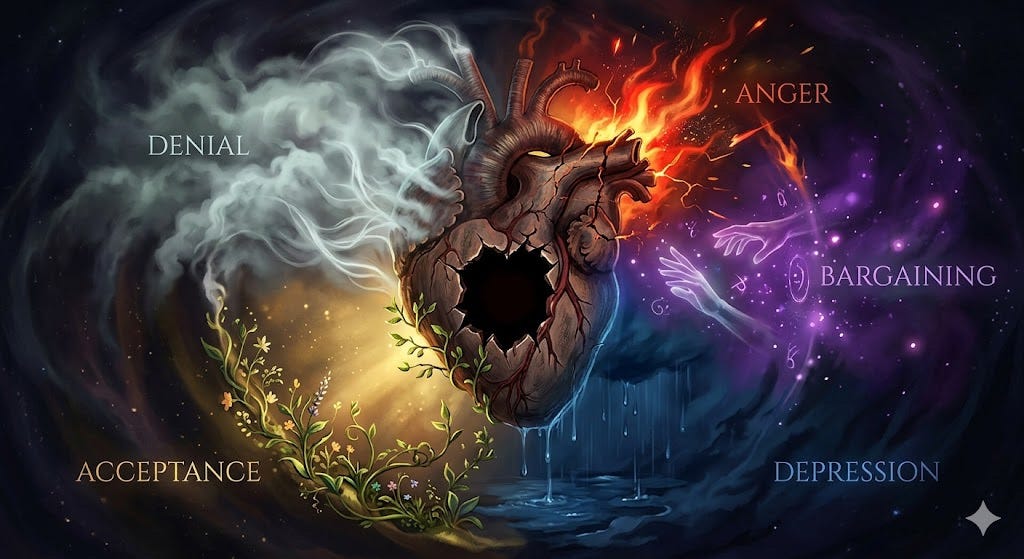
Merriam-Webster defines “hollow,” among other meanings, as having an unfilled or hollowed-out space within. This perfectly describes where I find myself after five plus years of total estrangement from our son. Actually, we lost him—the boy I birthed, raised, and loved dearly—eight years ago. Though he is back to living in the world as a man, he has not returned to our family as our son. He has completely cut contact with us, and we have no way to communicate with him.
When our son told us a few years ago that he had gender dysphoria and felt like a woman trapped in a man’s body, I went through all the stages of grief: denial, anger, bargaining, depression, and acceptance—not necessarily in that order.
I was in denial for about a year. Before his official coming out, I saw signs of what was happening but was paralyzed by fear and refused to accept that we were losing our son to powerful influences beyond our control. A year later, my son came out to me as a woman trapped in a man’s body, and I could no longer deny what was happening.
Next, I felt depressed and anxious. Our son started medicating with hormones while still living at home. Seeing the changes in his personality and body made me the saddest and most anxious I have ever been. His dad and I tried bargaining with him to stop the medical interventions, but our attempts only drove him deeper into his trans identity. Since he was unable to get us to accept him as our “daughter,” and because he wouldn’t agree to stop taking hormones in our home, he left for good and cut us off.
When our son left, I became angry. I was furious at the doctor who prescribed hormones, at the glittering friends and “chosen family” affirming him, and at all the agencies and people in power propelling the trans agenda. My anger led me to activism, where I worked hard in the parent underground. Tearing down “trans” became an obsession that consumed my mind and much of my time. I saw the fruits of our labor and experienced the satisfaction of laws passed to protect children from so-called gender-affirming care.
However, after a few years of intense activism, I felt stuck in the “trans world,” and it was preventing me from truly enjoying the rest of my life. My son was living his life away from us. Our other children were close by and eager to share life with us. I had local friends and a community from which I felt detached. I realized it was wrong to allow the trans cult and my estranged son to occupy so much rent-free space in my head, but I was afraid to let go of my son.
I met with a counselor to get an outside perspective on how to handle my desire to hold onto our son. He told me to assume that I had a life expectancy of thirty more years. He asked me if I wanted to spend the next thirty years worrying and pining for my son who didn’t care about me, was running away from me, and didn’t want anything to do with me. He completely re-framed what I wanted the rest of my life to look like. I reached a point of radical acceptance—accepting that there was nothing I could do to make my son change or come back to us. My only recourse was to pray and ask God to work in his heart and do what I was powerless to do.
I have been at the acceptance stage for a couple of years now. This has been a challenging process. At the beginning, I accepted that this was our present reality for an undetermined time, and that my son was in God’s hands. But I longed for him to come back home to us. On one hand, I had peace and the ability to enjoy the blessings in my life; on the other hand, I held on to our son, wishing he were here with us and wondering how he was doing. Increasingly, my son started being relegated to the back of my mind and I felt myself detaching emotionally from him. I missed him less and stopped envisioning the day when he would come back to us and re-integrate into our family.
My reckoning came early this year when I completely forgot his birthday. Right before I went to sleep, I remembered with a jolt what day it was and realized that not a thought had crossed my mind about it. It shocked and disoriented me to realize that I had totally forgotten the day my only son was born. I started wrestling with guilt and shame, wondering if I should keep hanging on—praying with more intensity and frequency, thinking more about him, talking about him—so that he didn’t fade completely from us. I also began to worry that letting go of our son emotionally, as his mom and as a family, would make it nearly impossible for him to re-integrate if and when he was to renew contact with us. So, I shared my thoughts with a group of trusted friends. One dear, wise friend said this to me:
“...acceptance is perhaps a self-protective element, and I believe that it is. I also believe that stages of grief, whether for those who have died or for those who are even far more painfully choosing to be away from us but still here on this earth, are not linear. Acceptance, even partially, of the situation that exists today, does not mean giving up on him or that you have to give up your ability in the future to re-integrate. It will always remain a choice, although there is uncertainty re: what it would look like. It is not deleted by moving away from hanging on. That love does not die, it does not cease, and a mama’s heart will forever know that love, but for protection, it is love that must be tucked away to continue to live and love those that need our love today (and we need theirs). If he ever should return, of course there will be much to repair, wounds to heal, and maybe I am too much of an optimist, but I do wholeheartedly believe that letting go of the anxiety-laden watching of the path for him to return home does not make it any less likely that he will (meaning it is not the anxious-watching that will bring him home). Even though you change your gaze to the present and future, you are not shutting down any path in the future. You are freeing your heart of anxiety. God will watch the path and every path, he always has and will always.”
This statement nailed it for me. My anxious waiting is not going to bring him home any sooner. Instead, I have freed myself of the anxiety by letting him go. I wrote The Prodigal Son about a year ago and in it, I said, “As parents of a prodigal son, we also anxiously await the return of our son. We look down the road to see if we see a glimpse of him.” But now I don’t find myself anxiously awaiting his return or looking down the road to see if he’s coming home. I have no expectations of my son. I have released him, along with any projected timelines and hopes, to God.
However, acceptance doesn’t fill the hollowness inside of me. There is a hole in my heart in the shape of my boy that remains unfilled. The thoughts about him have moved to the back of my mind during everyday life but come to mind as I pray for him daily. The empty chair during holidays and birthdays brings a twinge of sadness. The silence from his lack of acknowledgment on Mother’s Day, Father’s Day, and birthdays is deafening, but expected. Facebook reminders bring both a smile, as I remember the sweet boy he once was, and a pang of sadness for the boy who is gone. I am aware that the cycle of grief is not a straight line. There may be a change of the status quo that will bring me out of acceptance and put me right back into any of the other stages of grief.
Nevertheless, acceptance has allowed me to feel joy again. I am able to fully express my love to my other children with open arms and hold nothing back. Right now, I am living in a season of joy and don’t feel guilty for thoroughly enjoying vacations, holidays and birthdays without our son’s presence. When we celebrate or simply gather, I am fully present with the family, showing through words and actions that they are enough to bring great joy and fulfillment to me. Deep down, my mother’s heart still hopes that my son will come back to us one day. I pray daily for his well-being and return. Deo Volente, my prayers for his return home will be answered one day.
Thank you for “I worked hard in the parent underground” in some way I’m sure it has touched my life in a positive way somehow.
I’m so happy to hear you are able to be present with your family now. It’s awful feeling not to be and has so many negative repercussions.
I hope one day all the children return one day trans pied piper stops piping.
Your poignant writing made me so angry for you & your entire family. I just wish for one SECOND these trans supporters/deluded kids/cult followers/unethical doctors can see the absolute pain and horror they are wrecking on so many lives in promoting an idea that is fantastical at best and evil at worst. I'm so entirely sick of it.