
Republished with permission from DIAG.
If you’re a good writer, you can make anything sound sentimental and romantic. The tragic death of the gnat on your windshield. The strung-out junkie on a windswept night. The persecuted “trans” activist living in a shack by the sea.
But should you?
The gnat is a pest. The junkie is miserable. And the activist is actually a drug-addicted male prostitute in women’s clothes.
We should call things what they are. We should be unflinching when it comes to the truth.
James Marcus wrote poignantly and poetically in an early November issue of the New Yorker about his 26-year-old son, Nat’s slow-motion slide into trans ideation, but beautiful writing is not necessarily truthful writing, and in this case, the beautiful piece of writing is also a very well-crafted piece of propaganda. The pernicious message he broadcast out into liberal society? Surrendering to false ideologies is an act of love.
Marcus’s piece is an ode to self-annihilation, his child’s and his own.
When we deny the truth of our knowing as parents, when we agree to be ruled by fabrications and fear, we become formless. We allow the indoctrination-fueled confidence of our children to blur, move or eliminate altogether our moral needle, and distort reality. We let pathological empathy rule our minds instead of grounding ourselves in difficult truth. The parts of us that know right from wrong, reality from fantasy, shared memory from fiction, are put to sleep. Willful amnesia is perilous both culturally and psychologically, whether our child is 12 or 26, whether it is 1968 China or 2025 USA, and it must be actively resisted.
Marcus’s piece is an ode to self-annihilation, his child’s and his own. As his son, Nat, slips further into ideological beliefs, James heedlessly follows along, seemingly out of kindness. This is about as kind as getting into a car with a drunk driver out of empathy for their alcoholism. Marcus believes his doubt is “old-fashioned” and so he overrides his intuition, shoves the doubt into the backseat, and tells it to be quiet. He has no boundaries and no opinions: he’s not a participant in his own life. In response to a child’s insistent new language, high emotion, and confounding beliefs, adults can sometimes become infected too, and lose touch with their autonomy and agency. This is not parenting. It’s not even personhood.
Truths are often, by nature, inconvenient. That alcoholic may be angry if we refuse to get in the car with him, and we will be uncomfortable. We will both be upset when we try to take away his keys. We may refuse to be with him when he is drinking. We may refuse to give him money. We may tell him, “You’re hurting yourself and your family, and putting others in harm’s way. Alcohol will not solve your problems.” No one will enjoy this, yet still it must be said.
Like alcoholism, trans ideation features a relentless pull towards self-destruction, requires lying to yourself and everyone around you, and creates lifelong health risks, but society has deemed this vice a virtue. Hypnotised by this fallacy, Marcus fails to stay conscious long enough to even acknowledge his concern to himself, much less to Nat. He fails to say, “Son, no matter how much synthetic estrogen you buy from a Ukrainian on the internet, you will never be a woman, and pretending to be one endangers women everywhere. Son, discomfort and depression are a part of life and can be tolerated. Son, this drug will take your cognition, your fertility, and your cardiovascular health, it will increase your cancer risk—this should worry you. Son, I’m not going to discuss the changing size and shape of your nipples with you, and claiming you are experiencing ’P.M.S.’ makes me doubt your sanity.”
Marcus’s abdication is somewhat understandable. He knows the rules: submit to your son’s internet-manufactured fantasy, or risk losing him entirely. It’s a horrible choice, and most parents coping with a sex-rejecting child will probably face it at some point, and be ripped in half by anguish. But we can’t abandon reality, even for our own beloved child. Your child is not a member of a sacred class, they are not on a magical journey, and you are not meant to act as their universal cheerleader, nor should you enable their vices. Sometimes things feel right not because they are right, but because they are easier. James may retain his friends (though their value is questionable, given one of them thinks only “trans” kids understand the soul), his social status, his ability to publish his writing, and to keep his son in his orbit. This can feel confusingly like he is headed in the right direction because the way forward seems so clear. As the affirming parent sweeps the path ahead of the confused child, society sweeps the path ahead of the affirming parent, making that ease feel like truth. But they are not the same thing. Any comfort achieved through lies is temporary, and has dire consequences for society and for all our relationships—to ourselves, to others, and to reality.
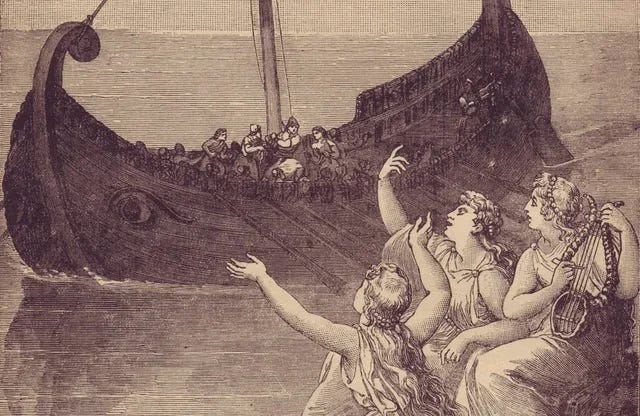
That Marcus was criminally incurious and didn’t investigate the societal forces putting wind in the sails of his son’s “identity” is part of why his 27-page homage to unreality seems to lack any substance. He’s telling the story of a shipwreck without ever mentioning the sea, or the sirens that beckoned the crew towards their doom. Greater forces than these two are steering this ship, though Nat is under the illusion that he’s navigating, while his father effectively plays a passive traveler, blithely watching the waves as the ship founders. Neither appear to have the strength or the courage to batten down the hatches and face the storm.
It’s unfortunate that James Marcus dreamily allowed himself to be sucked out to sea, but he also felt compelled to publicly glamorize his utter submission. It was not enough to quietly congratulate himself, he wants others to congratulate him, too. He unleashed this endless homage to somnambulism out into the world and onto other parents who might otherwise have listened to their most primal and protective instincts. These desperate parents may now lose their resolve, and strive to match Marcus’s blind fealty. His words wheedle us all to normalize the abnormal, and see the siren song as innocent and true. His wistful story frames Nat’s “transition” as a hero’s journey, undermining the efforts to open real discourse on this issue and its impact on women and children, making it more difficult to prevent young people from being damaged, and encouraging the crowd mindlessly cheering it on from the sidelines. In an environment in which no counter view is visible or even acknowledged, his message threatens the already fragile support systems for those parents who are striving to exit the sea altogether and bring their children safely to dry land. Marcus is no longer just a passenger on that ship. His essay cruelly beguiles other devoted parents towards the same treacherous rocks that shipwrecked him.
James, you will never find salvation in surrendering to the sirens, whose nature is to tempt, confuse, lie, and endanger—this is true no matter how poignant and poetic their song. When the siren calls, you must tie yourself to the mast of reality and truth. Yes, your child has been enticed away, and your heart is breaking, but no one is helped if you both are dashed on the rocks.
I'm appreciative of the author for this post. I felt almost disgust as I read James Marcus' New Yorker piece. His mourning his son at the start of his "transition" is superficial. His essay is self-congratulatory propoganda that ignores the reality of two sexes and of our sick culture preying upon confused people. His essay validates gullible, opportunistic, cowardly, and indifferent others. Marcus's awful essay triviolizes my broken son and my broken heart along with my fractured family -- and others who are enduring this relentless nightmare.
My favorite lines: "Like alcoholism, trans ideation features a relentless pull towards self-destruction, requires lying to yourself and everyone around you, and creates lifelong health risks, but society has deemed this vice a virtue."
"As the affirming parent sweeps the path ahead of the confused child, society sweeps the path ahead of the affirming parent, making that ease feel like truth. But they are not the same thing. Any comfort achieved through lies is temporary, and has dire consequences for society and for all our relationships—to ourselves, to others, and to reality."
Thank you.