
After We Win: Lessons from Lobotomy
A twelve-year old’s lobotomy might prepare us for what comes next, after we’ve “won”

After a decade of defeats, this last year has been good for parents like us whose families have been ravaged by “gender” and its Sex Rejection Industry. The feds have vowed to end pediatric Sex-Rejecting Procedures (SRP) and are standing up for parents' rights. The (woefully under-reported) first detransitioner’s lawsuit has succeeded, with many more coming.[1] Medical groups like plastic surgeons and the AMA are fleeing the fraudulent “consensus” for Sex Rejection. Long-time trans activist leaders are urging at least a tactical retreat (but note, he is not saying “we are the baddies and should surrender”). Our own Sage and Michele have been honored by the president on national TV. The president gets corrected and adjusts when he’s not based enough.
But even if we achieved total victory today—no new transings at any age, Nuremberg-style punishment for offenders, gender ideology in the trashcan—these successes won’t hide one brutal reality: we’ll still live in a world where thousands of young people have already been damaged. Those are our kids, trudging around like broken dolls, trying to make lives for themselves at age 20, 30, 40, and beyond—some alienated from loved ones, some haunting their families like a ghost. And don’t forget those who didn’t survive. Even with their likely shortened life expectancies, what will survivors do for the next year, decade, half-century?[2] What will we do? How will we all live?[3] Could history guide us in a post-trans era?
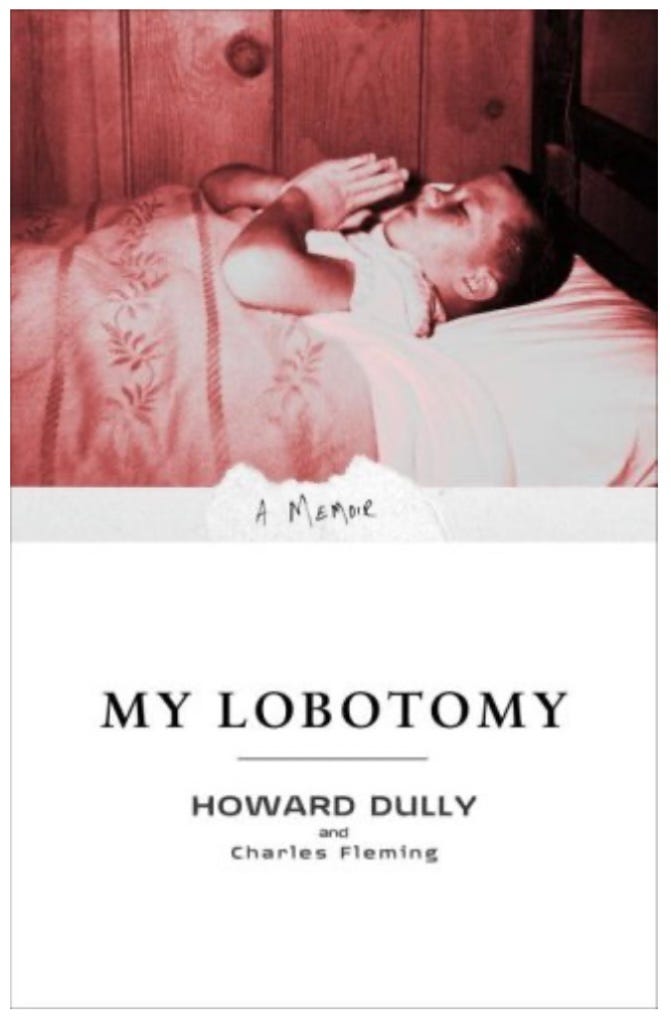
Society has seen medical errors and crimes before. From Tuskegee to eugenics to thalidomide, we PITTs have heard it all. Lobotomy is familiar to us. But I never connected the dots until I read the memoir of a man named Howard Dully. In 1960, at age twelve, he was one of the youngest patients ever to receive a “trans-orbital” lobotomy (TOL). He got his from TOL’s inventor, Walter Freeman. In 2005 Dully told his story on NPR and in 2007 in the best-selling book “My Lobotomy.”
Unlike many lobotomy patients, Howard survived. Unlike many, Howard was not “erased.” To his credit, this man persisted and eventually built a somewhat normal life. But how he suffered along the way! The years of sadness and uncertainty, of bouncing from institution to institution, of petty crime, of drink and drugs, of random sex and accidental pregnancies. (Parents used to fear their teens would get pregnant. Our kids would be lucky to find happy, albeit empty, random sex—who wants a tranny?[4]—and to procreate if they’re not already made infertile.) He died only last year, at age 76, with a wife and kids. (Will our damaged kids live that long, or have kids of their own?) God bless him. God grant him some peace. And grant us some wisdom.
Six lessons from “My Lobotomy” hit me hardest:
1. A loving, involved biological parent is a child’s best protection. No shade on the countless good nonbiological-parents, but Dully’s stepmother was the bad guy, lying to get him lobotomized (page 230), and Dully’s father failed to protect him. A child with an unloving or checked-out parent has no protection. Protection against what? Monsters, of course—but also well-intentioned but misguided experts. Understand, the medical system can’t be guaranteed to safeguard the patient’s well-being, even when the money’s paltry; the Dullys paid a mere $200 ($2,200 today) for Howard’s lobotomy. The whole point of Freeman’s innovation, the transorbital lobotomy, is that it’s not difficult or expensive. And it’s one-and-done, not a recipe for a lifetime patient. If medicine can’t be trusted when the money’s bad, it really can’t be trusted when the money’s good. CPS and the care industry are just as complicit. Howard needed a protector. And today, loving parents are not enough when our entire system is screaming “CUT ‘EM!”
2. The human spirit can overcome a lot. But it shouldn’t have to. We shouldn’t invent obstacles. Without lobotomy, young Howard would have grown, most likely, into a normal man and led a normal life. “The more time [Dr. Freeman] spent with me, the more normal he found me.” I realize it’s an autobiography, but Howard sounds like an okay kid, the sort of rambunctious but 100% not-pathological boy we all knew and maybe liked when we were kids. PITT dads, read this book; I bet many of you will say “sounds like my buddy” or “sounds like me.”
3. Money is no protection. Dully’s family was not rich, although they did manage to live in a really nice town, Los Altos, California. Today? Money gives zero protection from trans. Money makes it worse! Hollywood and Silicon Valley and Manhattan are hotbeds. The Trillionaire’s son, Xavier Musk, has become an obnoxious trans activist. Critics accuse public schools of promoting trans, but expensive private schools are some of the worst offenders.
4. Don’t seek medical solutions to social problems. This kid was not schizophrenic.[5] He was not crazy at all. He was unfortunate and unloved. He fell into the perfect storm between an impatient stepmother, a cold and uninvolved father, and an enthusiastic, entrepreneurial doctor. Ice-picking Howard’s brain was one way to try to solve his problems, but cutting him some slack or loving him some more or simply doctors leaving him alone to grow up and solve his own problems might have worked a lot better. Best of all: admitting that “his problems” were mostly his parents’ problems.
5. Dully aimed his story at us. Dully ends his memoir stepping back and comparing his 1960 lobotomy to 21st century children who are diagnosed with depression, bipolar disorder or attention deficit hyperactivity disorder without a second opinion, and are subsequently overmedicated. His 2007 book could not have anticipated today’s Sex-Rejecting Procedures (and the NPR and NYT opinion media might not have permitted him to decry it), still it’s heartening to see that Dully’s empathy remained intact. His tragic story from 1960 applies to young people today. And he knew it.
6. There’s no easy way out. Now I’m speculating. Will doctors invent some way to undo Sex-Rejecting Procedures? I’m not optimistic. Once it’s clear that there’s a fortune to be made, why would those doctors be any more ethical than the doctors who created this problem? No, I think we’re stuck with this. Sure, the MTFTMs can cut their long hair. The FTMTFs can shave their faces. But will the MTFTMs get their balls back? Will the FTMTFs get their soft voices back, let alone their wombs or real breasts? Will any of them have any chance of finding love?[6] Of making babies? I treasure detransitioners (and hope that my kid will join them) and I pray for their futures—but I’m realistic. Even the honest doctors who’d try to help them admit there’s only so much that can be done.
IT’S WORSE TODAY
We’re shocked that child lobotomy was sold as “care,” but today experimental drugs and clumsy amputations are sold as “care.” Lobotomy was bad... well, SRP is worse. The world is worse. Compare then and now:
1. Money took over. THEN: Lobotomy was cheap and Freeman deliberately was not making a fortune doing it. He had other motives. He was desperate for a cure. He was a grandstander. But he was not a profiteer. The opposite, he cut corners because he wanted lobotomy to become cheap and common. NOW: Trans is “a huge money-maker” for hospitals, to the point that critics and whistleblowers are seen as a threat to be crushed. Captured legislators forced insurers to pour money into the machine, so of course incentives follow.
2. Politics took over. By coincidence, Howard began seeing Freeman just as the 1960 election came to a close. Imagine Kennedy or Nixon praising the mutilation of children. But Biden did just that in the 2020 election. We live in an age when everything is politicized, and somehow transing children has become a potent political marker. These people are crazy.
3. Darker motives took over. Then: Freeman was not a creepy fetishist; he did not mutilate himself, then mutilate children to normalize himself. Now: Yes, trans attracts money and politics, but trans has other motivations, too: Epstein’s emails to Prof. Robert Trivers and perhaps Dr. Jess Ting give a glimpse into what many long suspected, that it’s about manufacturing a new sexual plaything for pervs. Genevieve Gluck reports that top academic researchers promote sexual fantasy fetish websites about doctors raping and castrating children, then publish papers with titles like “Choosing Castration”—voila, doctors advertise creating “nullos” and “smoothies.” And on the parent side, then there was no prestige in lobotomizing your child—the opposite. Now there is a twisted prestige in transing your child. That’s why it’s big in Hollywood.
4. The process has gotten worse. Dully wrote “[in 1960] it had taken less than two months, and four visits from [my stepmother], and four visits with me, to convince Dr. Freeman that a transorbital lobotomy was the only answer to our family’s problems. That’s how easily the decision was made.” We think of lobotomy as barbaric, but reading Dully’s book I was struck how careful and thorough Dr. Freeman was in evaluating young Dully’s case. At least by 2026 Gender standards. There are parents here at PITT (and here and even in the NYT comments) who wish the doc spent two months and multiple visits actually talking to, and listening to, numerous extended family members before giving a diagnosis and treatment plan. I’ve never met our Dr. Frankenstein.
5. The science has gotten worse. Freeman diagnosed 11-year-old Howard with schizophrenia since age four (page 125). Now, that diagnosis is nuts—almost no kid is schizophrenic, see above—but at least schizophrenia is something real. Gender dysphoria? No. In both cases an adult diagnosis crept into children’s medicine. And brain surgery, even in 1960, had some proven clinical successes and some basis in science. Today’s gender medicine, with spirits inhabiting bodies and decisions based on spectral evidence? It’s closer to Salem 1692 than California 1960.
6. The incentives have flipped backwards. Then: We think of Freeman as a butcher, but he would never have operated if a parent had not come to him first. The result is horrific, but at least the process makes sense: adults with legal authority started the process, then consented to the work. Now: The child starts the process. Adults with zero legal role can shepherd the child along: first socially, then medically. (Teachers, I’m thinking of you.) Parental consent means little and parents lack even veto power; every single one of us PITTs screamed “no, don’t do this!” yet a doctor did it anyway. Parents don’t even get to know what’s happening.
7. The guardrails are weaker. When they work properly, the medical system’s guardrails (or negative feedback mechanisms) prevent harm. Example: In late 1960, the very moment Dr. Freeman was ice-picking Howard, Dr. Frances Kelsey was building the case against thalidomide. Thank god she did: her negative feedback, coupled with the FDA’s institutional power, saved thousands of American children. Then: TOL had no advocates or “activists” besides its practitioners, and many skeptics and critics. Certainly no one would attack you if you opposed lobotomy. Freeman was booed off the stage at a medical conference (in SF, of all places) to which he brought three young patients (page 103); it seriously damaged his reputation (page 188). Now: Dismantling guardrails and silencing negative feedback mechanisms is a defining tactic of trans. Just ask Dr. Eithan Haim and other professionals who questioned trans. Haim was almost annihilated for it. Writers like Meghan Murphy and even humorists like The Babylon Bee were silenced.
8. Kids have less support. Then: Howard’s other family members stood up for him both before and after the lobotomy. His grandmother fought long and hard for him after it. (page 109) “She demanded to know who allowed the surgery to go forward. ‘Who can assume or give moral authority and take responsibility for such an act?’” I like the lady. Now: Skeptics, even parents who should have legal authority, feel the deck is stacked against them. They’re right, it is.
9. Parents must have the veto. Parents are not perfect. They make mistakes—today some promote transition—but to silence and disenfranchise parents ensures trouble. Then, Dully was lobotomized with the assent of parents, and would not have been without it. Now, courts and politicians take kids from parents so they can be transed. (Note: one trial at Nuremberg specifically went after judges and lawyers who committed crimes against humanity through the abuse of the judicial process. Hmm.)
WHERE WE STAND
Our recent victories lift my heart. Reading Dully gives me perspective and a moral guidepost for a post-trans world. But the realist in me can’t escape thinking: There is no going back to normal.
If we’re lucky, hundreds of doctors will be jailed for years. Thousands of careers will be ended. Dozens of institutions will shut their bloody doors. Billions in damages will be paid. A few people will be charged with crimes against humanity. No further mutilations and poisonings will take place, at any age. But how many young people will already have been damaged? How many young people are dead now because of this abomination?
The world will spend the next half century processing this horror (hopefully avoiding further horrors). Dully’s memoir connects his struggle to ours. And unlike most lobotomy or sterilization victims, gender victims—our kids—will be walking among us every day, reminding us of what happened. Also unlike lobotomy or sterilization victims, gender victims are disproportionately smart and articulate.
What do we do?
1. Forgive. It will be hard, after all the stupid, useless, unnecessary pain our kids put everyone through. But when the prodigal son or daughter returns, we’ll have to do our best to forgive. And to reintegrate them. It’ll be hard, but what choice do we have?
2. Welcome. Behind enemy lines are hidden friends eager to cross to our side. Let’s welcome defectors. Glenna Goldis was a consumer protection attorney working for New York State attorney general Letitia James. James is a relentless promoter of trans and of SRP for kids—but Goldis, a lesbian progressive, believes in protecting gender nonconforming kids. During her four years working for James, Goldis tried to sound the alarm about SRP harming kids. In January, James fired her for it. Well, Goldis just started work for the feds, investigating SRP as consumer fraud! Welcome. Make the bastards pay, Glenna.
3. Listen and amplify. And tell your stories. “First-generation detransitioners”—like Chloe Cole and Helena Kerschner, who were harmed as minors during the early days of SRP—are incredibly brave and articulate and empathetic. Like Dully, they exemplify a victim turning around and showing courage and empathy for others. (And other lobotomy victims came to appreciate Dully speaking out, see page 222.) They are essential to fixing this mess. But soon thousands more young people will come crawling out of this wreckage, all with stories of their own. And we parents have our stories. They’re all important and must be told, and heard, and amplified—while avoiding the trap of “poor me” victimhood (page 269). Life has to go on. Make the best-selling memoir of 2036 My Mastectomy or My Castration.
4. Punish, punish, punish. If we want to promise future generations that this never happens again, we need to punish everyone who did this. Severely. Think post-WW2 de-Nazification and the Subsequent Nuremberg Trials. Corporate executives in prison cells. Lawyers and judges and politicians receiving lifetime sentences. Medical doctors hanged. America did that; we should be proud. We should do it again and build monuments and museums to it. If we don’t, this will only happen again. This is designed to happen again. Happening again and again is the whole point, the only point. Read Halperin and other Queer Theorists: “queer” is not for anything, it’s only against normalcy—however you define normalcy this instant.[7]
Beyond that? No idea. We’ve had some momentous victories lately, but we’re fools if we get complacent. I think there’s some hard times ahead. What do you think?
One does not detransition from lobotomy, but Dully survived and built a life and told his story. He knew we needed to hear it. He maintained empathy. He recaptured dignity. I recommend “My Lobotomy” to anyone serious about how we’ll live in a post-trans world, after we’ve won.
NOTES
Let’s keep a list of law firms. To start: Adam Deutsch, who just won $2M for Fox Varian; Josh Payne, who formed Campbell Miller Payne in 2023 to represent detransitioners / ex-trans litigants; Center for American Liberty; and Dhillon Law Group. Help make them rich and famous!
I sure hope the “Canadian healthcare option” doesn’t catch on in the US… Unhappy? Ask your doctor if euthanasia is right for you!
Helen Joyce, who famously predicted that gender-affirming parents will be the dead-ender Japanese Imperial soldiers of the 21st century, asks “What happens to those caught up in the social contagion, once it has passed?” The moms who transed their kids, Joyce argues, will dig in and never relent. The trans-identified population will be split and polarized. Trans families (meaning, us) will be split and polarized. It won’t be pretty.
“Will Straight Men and Women Date a Trans Person? Evidence suggests the answer is often no—but why not?” (Savin-Williams, 2021)
Almost no kid is schizophrenic. Childhood-onset, defined as onset before age 13, accounts for 2% of all schizophrenia cases. Early-onset schizophrenia, age 13-18, is 6%–10%. The typical late-adolescent or adult-onset profile, age 18 and above, is 88-92%.
The odds are not good. See Savin-Williams above: “Extremely few straight men and women would consider dating a trans individual.” “The most surprising finding is that a large number of queer and nonbinary individuals would not date their ‘own kind.’”
They really do say that. “Unlike gay identity, which, though deliberately proclaimed in an act of affirmation, is nonetheless rooted in the positive fact of homosexual object-choice, queer identity need not be grounded in any positive truth or in any stable reality. As the very word implies, “queer” does not name some natural kind or refer to some determinate object; it acquires its meaning from its oppositional relation to the norm. Queer is by definition whatever is at odds with the normal, the legitimate, the dominant. There is nothing in particular to which it necessarily refers. It is an identity without an essence. “Queer,” then, demarcates not a positivity but a positionality vis-à-vis the normative—a positionality that is not restricted to lesbians and gay men but is in fact available to anyone who is or who feels marginalized because of her or his sexual practices: it could include some married couples without children, for example, or even (who knows?) some married couples with children—with, perhaps, very naughty children. “Queer,” in any case, does not designate a class of already objectified pathologies or perversions; rather, it describes a horizon of possibility whose precise extent and heterogeneous scope cannot in principle be delimited in advance.” (Halperin, Saint Foucault page 62.) Gather some firewood. Similarly, “normalizing the queer would be, after all, its sad finish” (Judith Butler) and “queer maintains a relation of resistance to whatever constitutes the normal” (Annamarie Jagose, Queer Theory). This is a call for a never-ending transgression of all boundaries, one after another after another...
Wow. That's an amazing article, which I need to re-read and check out the links! Thank you for your work.
Have to say, the PITT articles are the ones I find the most moving, ie heart-breaking... I'm an elderly woman who is child-free and I've been asked why I care so much about this (“trans”) issue. I can only respond with “why would you NOT care?!” The whole thing seems totally grotesque and wrong. I honestly need a stiff drink before I can go on 'X' and follow what's going on... but feel I have to do my very small part in pushing back against the insanity.
what makes the medica industry's crimes against humanity in gender ideology is the addition of education and government pushing it